What this buyer guide helps you decide
Identify the load, enclosure and sensor questions that a battery thermal review must answer. This guide is written for importers, technical sourcing teams and OEM/ODM buyers who need to make an informed decision rather than rely on a product photograph or label. The goal is to identify the documents, reference samples and review questions that would make a technical discussion specific and actionable.
Use this article as a review framework, not a substitute for qualified engineering validation. The right outcome may be to request more evidence, change the requirement or postpone the purchasing decision until important interface or safety questions are resolved.
Where pack heat may originate
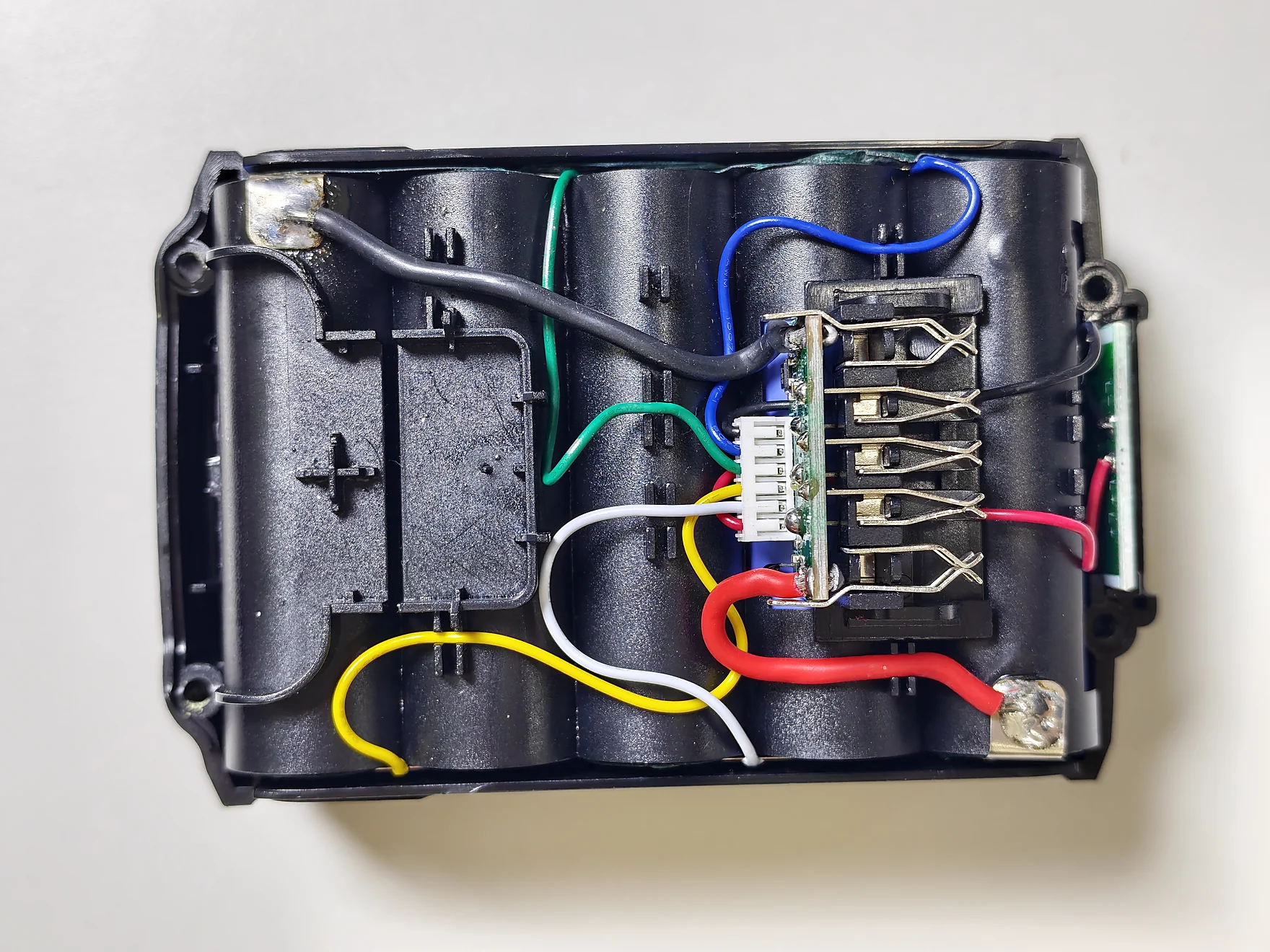
Heat can arise in cells, conductors, protective devices and electrical contacts when current flows. The distribution depends on component characteristics, internal resistance, workload, duty cycle and the environment. The opened-pack photograph helps locate physical elements but is not a thermal scan or measurement. Buyers should define the actual application, sustained power levels, startup behavior and ambient operating range before judging any thermal design.
Buyer action: record the exact application and target model or design revision first. When a supplier responds, ask which part of the statement is a generic engineering principle and which part is supported by information for the battery being quoted.
Layout and enclosure influence temperature
Dense packaging saves space but may affect local temperature distribution and the available paths for heat transfer. Evaluate cell spacing, supports, insulating layers, adjacent heat sources, enclosure surfaces and the location of any sensing devices. Do not assume that a vented appearance or a certain plastic color establishes cooling performance. Discuss mechanical and electrical requirements together, including tolerances, protection against damage and limits on available space.
Buyer action: ask for a drawing, datasheet or interface definition that can be compared against the physical reference. Treat any unverified number, claimed certification or visual inference as an open question rather than an approved requirement.

Sensors, controls and operating limits
A temperature sensor is useful only when its placement, accuracy, interface and controller response are appropriately specified. Ask which conditions are monitored, what the system does when a limit is approached and how these decisions are validated. Do not use example temperature thresholds from an unrelated pack as a product promise. The appropriate protective behavior depends on the cell datasheet, the tool architecture and the agreed application requirements.
Buyer action: coordinate electrical, mechanical and sourcing reviewers instead of letting one successful demonstration stand in for all application conditions. Record open issues and the owner responsible for the answer.
Build a validation plan before testing
A review plan should state load profiles, initial state of charge, ambient conditions, measurement locations, instrumentation, repeatability and acceptance criteria. Require traceable results linked to a known hardware/firmware revision. If a temperature rise is claimed, ask for the corresponding plot and test setup, not merely a statement of 'good thermal management.' Until such records exist, describe proposed design considerations rather than verified thermal performance.
Buyer action: write the evidence requested, the relevant revision and the agreed acceptance conditions into the project file. This makes later quotation comparisons and sample approvals easier to audit.
Procurement worksheet: information to request
Use the following fields to create a comparison that another reviewer can follow. An unfilled field should stay marked “to confirm”—do not assume that an equivalent-looking sample has the same underlying specifications.
- Load and duty-cycle description
- Cell datasheets and operating limits
- Ambient and enclosure conditions
- Temperature-sensor locations
- Thermal test setup and accepted limits
- Revision identifier and test report
For each response, store the supplier document reference, its revision, date, and the person responsible for approving it. The checklist supports discussion; it is not evidence that any test or inspection has already been completed.
Frequently asked buying questions
Does a vented case prove the pack runs cool?
No. Enclosure appearance does not demonstrate heat distribution under the intended operating conditions.
Should all packs use the same temperature limit?
No. Limits and response logic depend on the selected cells, electronics and application requirements.
A practical buyer decision scenario
A compact housing looks efficient in a CAD screenshot, but the intended application includes long continuous use. The geometry alone does not establish that cells, conductors and protection electronics stay within allowed operating conditions. Define a load cycle and ambient range, identify measurement points and agree acceptable results with the responsible engineer. Compare prototype evidence against those conditions. If a claimed temperature profile lacks sample identification or test setup details, request the underlying report before it influences procurement approval.
Review record
For each item below, name the evidence source and keep unresolved findings separate from confirmed results. Copy the rows into the project review file rather than relying on memory or a sales chat.
| Information to verify | Source and revision | Decision status |
|---|---|---|
| Load and duty-cycle description | Document / revision / responsible reviewer: __________ | Open · Confirmed · Not applicable |
| Cell datasheets and operating limits | Document / revision / responsible reviewer: __________ | Open · Confirmed · Not applicable |
| Ambient and enclosure conditions | Document / revision / responsible reviewer: __________ | Open · Confirmed · Not applicable |
| Temperature-sensor locations | Document / revision / responsible reviewer: __________ | Open · Confirmed · Not applicable |
| Thermal test setup and accepted limits | Document / revision / responsible reviewer: __________ | Open · Confirmed · Not applicable |
| Revision identifier and test report | Document / revision / responsible reviewer: __________ | Open · Confirmed · Not applicable |
Once the buyer and supplier have agreed the open questions, the next step is a revision-specific sample or document review. No illustrative image in this article should be treated as a passed test.
Sources and verification boundaries
This is an educational buyer checklist. Sample imagery illustrates visible components and handling situations; it does not demonstrate performance, factory ownership, compatibility approval, testing or certifications. Validate any model-specific statements using the manufacturer’s current datasheet, approved drawings, test records and applicable shipment rules before relying on them for procurement.
For a commercial project, request records identifying the offered hardware revision and consult a qualified engineering or dangerous-goods professional where appropriate. VOLTBATT has not represented the illustrative photographs as a verified specification for your particular application.